India's AI Agents Will Have to Earn Our Trust
By Om Umrania
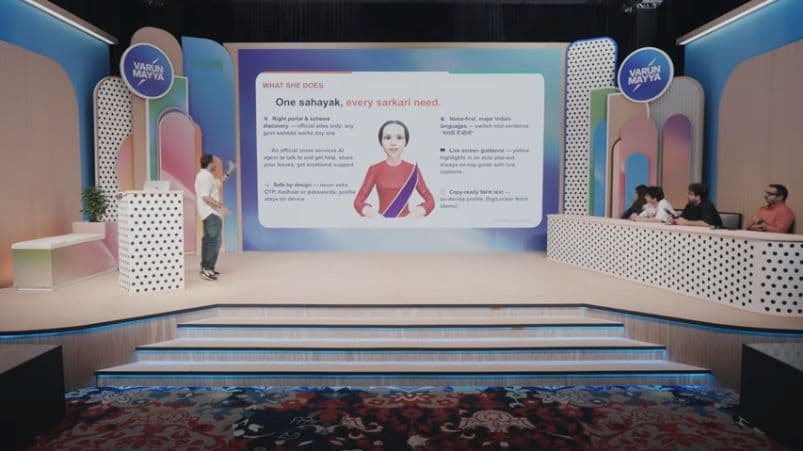
Cover: JanSewak presented at the Build What Moves India finale. Screenshot from Varun Mayya's Build What Moves India video, 38:05.
A person trying to report a scam needs to know what to do next. A family searching for blood needs a reliable way to reach the right people. A freelancer needs to understand which obligation applies to them.
Each of these is a workflow problem. The person has a goal, but reaching it means finding information, interpreting requirements, preparing documents and moving between systems.
Reading through the ten finalists in Build What Moves India, that is the opportunity I keep coming back to: AI could help people carry a task through those steps, with less confusion and a clearer sense of what has actually been completed.
My view is that trust and human control will decide whether AI agents earn a place in Indian workflows. Reducing effort matters. People also need to understand what an agent is about to do, choose what authority to give it, and verify the result.
An agent that handles a task quickly but leaves me unsure whether it submitted a form, shared a document or made a payment has created a new problem. I want assistance that makes the process easier to control as well as easier to complete.
These ten projects offer an interesting starting point for that conversation.
What these finalists actually tell us
Build What Moves India is an independent initiative presented by Varun Mayya in partnership with OpenAI. The organizers asked builders to improve an Indian public-service journey and explicitly required mock or synthetic data where sensitive information or government systems would be involved. Government adoption was not promised. Event FAQ, builder brief.
That context matters. These projects illustrate directions builders are exploring. They do not establish a national adoption trend or prove that the underlying services can already be delivered in production.
There is another distinction worth keeping: an app built with AI is not necessarily an AI agent. AI can help write the software, explain a requirement, or prepare a document. An agent goes further by using tools to carry out steps toward a goal. A useful product may combine those approaches with ordinary rules and search.
I would read this set as ten experiments in improving workflows, with different degrees of AI assistance and proposed automation. The ten teams include fourteen credited builders. Their work is more interesting when we look at the specific problem each one chose.
Ten projects, ten points of friction
The order below follows the source video's chapters, rather than prize ranking. Descriptions draw on a research guide checked on 10 October 2026, alongside the organizer directory and linked project pages. The screenshots show selected moments from the presentations; they do not verify live service delivery. Source video, organizer directory.
1. Samarthan: turning a distressing account into a structured complaint
Built by Amrudh Vishal and Parichay Prabhu, Samarthan explores voice-led cybercrime reporting. It structures a person's account and guides them toward next actions, including a simulated 1930 handoff.
The opportunity here is to help someone communicate clearly when they may be distressed. An assistant could ask for missing details and prepare a complaint for review. The research guide identifies the bank-freezing, police-dispatch and case-status flows as simulations; the prototype does not submit to those institutions.
For me, the design lesson is that assistance should reduce confusion while being precise about which actions have actually happened. Project, source.
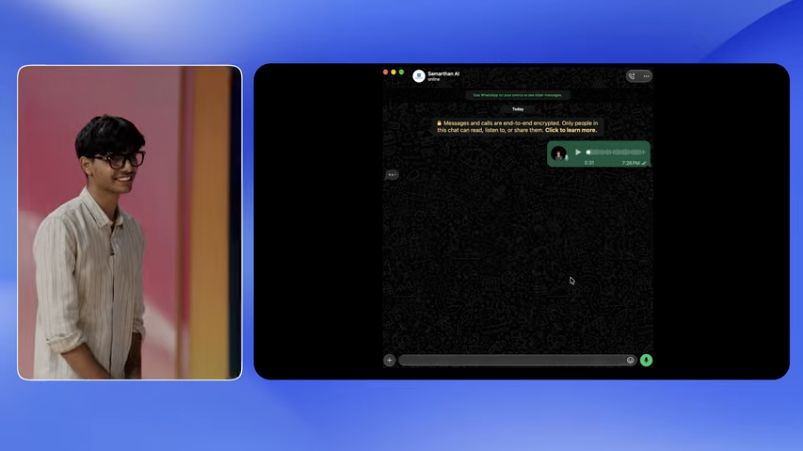
Samarthan demonstrates voice-message intake in its in-app WhatsApp simulation. Screenshot from Varun Mayya's Build What Moves India video, 03:16.
2. RaktKhoj: coordinating a search under pressure
Built by Gurjot Singh Ahluwalia and Sanan Goyal, RaktKhoj proposes an emergency-blood discovery journey involving nearby blood banks, compatible donors and donor responses through WhatsApp.
Its appeal is the possibility of bringing a fragmented search into one coordinated flow. But a suggested match and a confirmed, clinically appropriate source of blood are different outcomes. Fresh availability and verification would matter as much as the interface.
The guide describes an independent prototype, rather than a deployed emergency service. I see it as a strong reminder that healthcare workflows need reliable handoffs to hospitals and blood banks. Project, UMANG demo presentation.
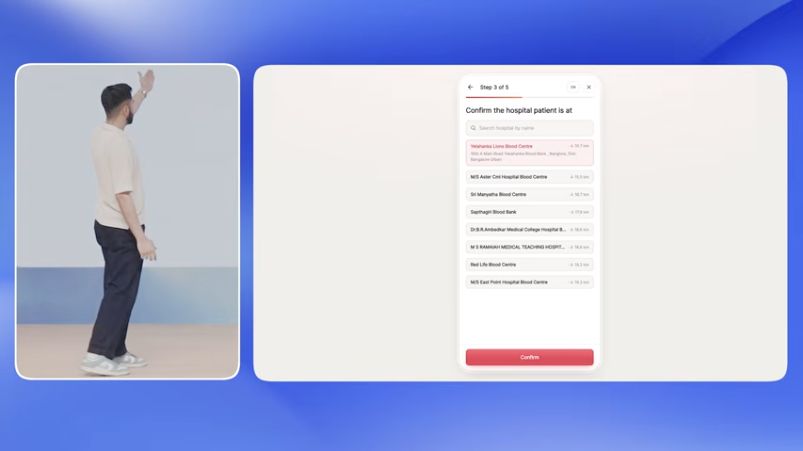
RaktKhoj shows a hospital-confirmation step in its prototype journey. Screenshot from Varun Mayya's Build What Moves India video, 08:47.
3. Nagrik: making public records usable
Built by Vyom Bhatnagar, Nagrik brings civic information such as public works, tenders, contractors, spending, contacts and source records into an accessible interface.
Its creator describes a familiar question: who is responsible for this road, footpath or drain? The project makes it easier to follow that question into public records, while explicitly identifying itself as independent of government. Creator's explanation.
This is the information foundation an agent would need before it could offer useful guidance. My takeaway is that an answer should come with a record someone can inspect, and an honest indication when information is missing or may be old. Project.
4. Atithi: clarifying requirements before the application
Built by Janvi Mehta and Sarthak, Atithi reimagines the Indian e-visa journey through early eligibility checks, document guidance, family applications and proposed passport extraction. The supplied guide records an unresolved surname discrepancy for Sarthak, so I am using his first name here.
The current interface also advertises connections to compatible AI agents, with the user reviewing the details. It remains labelled a hackathon prototype. Project.
The product lesson is to resolve uncertainty early. Helping a person understand which route and documents apply could prevent effort spent on the wrong application. Official submission, payment and approval would still require verified integration; the guide did not test them.
5. ekNaksha: giving complex records a familiar interface
Built by Harsh Karanpuria, this project was entered as NakshaFix and now appears as ekNaksha. It brings Udaipur land records and cadastral boundaries onto a map for easier inspection.
A map gives people a concrete place to start. They can locate a plot, inspect its number and compare available records with their papers. The site itself explains that a map alone does not prove ownership. Project.
For an AI-assisted workflow, that distinction is essential: interpreting a record can help someone prepare questions, but it does not settle ownership or replace verification of current records and ground boundaries.
6. JanSewak: assistance inside the existing journey
Built by Shivam Kumar Pathak, JanSewak is a speaking, browser-based AI copilot intended to guide people through government websites, schemes and forms.
The guide describes a model in which people review and submit forms themselves on official portals. Its voice operation was not exercised in that research.
This is one of the directions I find most relevant to adoption: help people use a service where the work already happens. The next question would be how reliably that guidance survives changing page layouts, ambiguous requirements and language differences. Assistant, source.
7. Karz Setu: starting from the business event
Built by Arnav Madan and Aishwarya Pokharna, Karz Setu helps map a business event to the relevant MCA form, supporting documents and signatories, while leaving filing under a person's control.
Its interface starts with what happened in the company, such as taking or repaying a loan. That is a useful design choice: people can describe an event more naturally than they can identify a form number. Project entry.
The guide identifies a preserved finalist version using synthetic data and submitting nothing to MCA. My takeaway is that AI can translate business context into a preparation workflow, with a responsible person reviewing the result. Finalist build.
8. My Next Filing: deciding what needs attention next
Built by Sarthak Mishra, My Next Filing helps supported freelancers understand their next tax-related action, estimated amount and due date.
The current repository describes local, versioned rules and calculations in the browser. It says users file and pay outside the app, and that the app cannot verify government acceptance. That makes it a useful example of why we should distinguish a helpful workflow product from an autonomous agent. Project source.
The lesson I take from it is prioritization. A clear next action can be more useful than a large collection of information that the user still has to interpret. App.
9. SevaSetu: carrying context between services
Built by Kiran Raj, SevaSetu explores connected Karnataka-service journeys in which previously supplied information and documents can be reused across related tasks.
Its interface uses buying a house as an example of a goal that spans several services. The research guide records mocked government adapters, so the demo's continuity should not be read as a live institutional connection. Project.
This highlights a substantial opportunity for agents: retaining context as a task moves between steps. In a real implementation, the user would need to understand what information is being reused, where it is going, and how to correct it.
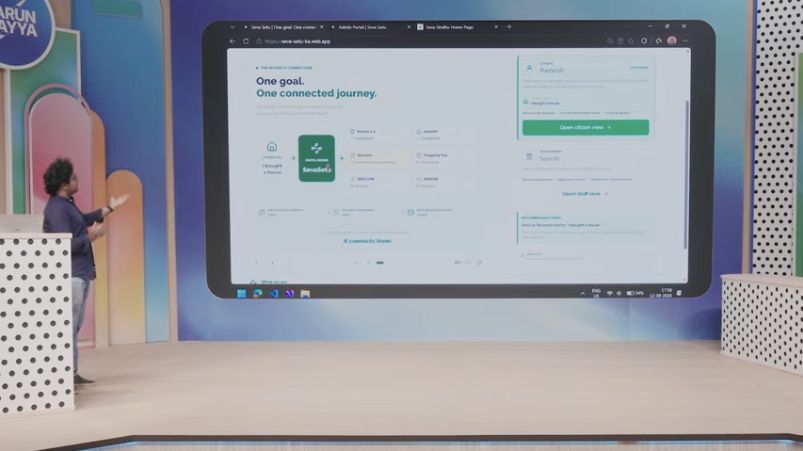
SevaSetu presents its connected-service journey concept. Screenshot from Varun Mayya's Build What Moves India video, 43:05.
10. RailSetu: planning around the traveller's constraints
Built by Ankit Shrivastava, RailSetu looks for continuous confirmed segments on the same train when the end-to-end journey is waitlisted. It makes seat and coach changes visible and considers traveller comfort.
The site says live inventory, reservation locking, payment and official ticket issuance use representative data or simulated integrations. Project and limitations.
What interests me is the planning problem. An option involving several changes might work for one traveller and be impractical for another. An agent should carry those preferences through its reasoning and clearly distinguish a proposed itinerary from an actual reservation.
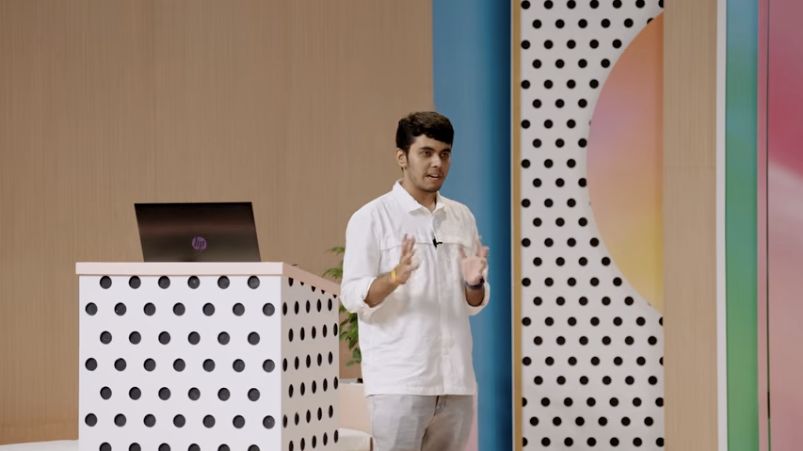
RailSetu presents its same-train segment-planning concept. Screenshot from Varun Mayya's Build What Moves India video, 45:00.
My take: useful assistance needs visible human control
Across these projects, I see three questions repeating: What applies to me? What do I need to prepare? What happens next?
Those questions give AI a practical place in a workflow. A person can describe their situation, get help assembling the relevant context, review a proposed step, and continue with a clearer understanding of the task.
I think that is a promising route for adoption in India. An assistant could work alongside a citizen, a freelancer, a service operator or a staff member. It could help them navigate the process while making the status of each step visible.
But usefulness is only the beginning of my argument. I would hesitate to delegate a consequential task if I could not see where the agent's authority began and ended. Human control should be part of the workflow: review the information, understand the proposed action, approve it where needed, and retain a way to stop or correct it.
India also contains many different contexts. A voice interface that works in one language may struggle with another language, accent or mixed-language conversation. A smooth desktop demo may be difficult to use on a basic phone or a slow connection. Those are questions to test with the people who would use the service.
My hypothesis is that agents will earn more trust when both the task and its controls fit those existing habits and constraints. Voice, messaging, browser guidance and document reuse are possible ways to do that. A review screen is only useful if the person can understand it. These prototypes suggest directions; they do not yet tell us which approach people will adopt or keep using.
The handoff is where trust becomes concrete
There is a significant difference between preparing a complaint and submitting it, between estimating a tax amount and paying it, and between showing a train option and issuing a ticket.
I would want an agent to make those transitions unmistakable:
- Before acting: show the proposed action, the information being used and the intended recipient. Let the person correct the details and approve consequential steps.
- While acting: make progress visible and provide a meaningful way to stop further actions. If something has already been submitted or paid, say so clearly.
- After acting: provide a receipt or other verifiable result, explain any failure, and show the available route to correction or human help.
An explanation should also identify its sources and uncertainty. A fluent answer is easier to trust when a person can check the evidence behind it.
Human review should match the consequence of the action. Someone can inspect an explanation without much risk. Sending identity documents, making a payment or filing an official declaration requires more deliberate control. A workflow also needs a way to recover when information is wrong, a portal changes or an integration fails.
This is where product design and institutional cooperation become inseparable. The interface can make a process easier to understand. Delivering the outcome requires authorized access, current data and someone accountable for the service.
What would make me believe this is working?
The next evidence I would look for is whether people can complete a real task more reliably with the assistant.
For a pilot, I would measure completion time, errors that require rework, drop-offs, successful handoffs and the amount of human intervention needed. I would also ask users to explain what they had authorized, what the agent had done and what remained their responsibility. I would test whether they could correct information or stop the next action when needed.
That would give human control an observable meaning. A confirmation button alone would not tell me whether people understood the decision they were making.
Those results would help test my view. If the assistant adds another layer of confusion or produces plans that cannot survive contact with the actual service, the workflow needs to change.
Build What Moves India gives us ten concrete starting points. What I find encouraging is the choice of problems: distressing reports, urgent searches, obscure records, repeated documents and uncertain next steps.
My bet is that AI agents will become useful in India one completed task at a time. Adoption will depend on whether people trust the process enough to delegate the next task. That trust has to be earned through dependable results and control people can actually exercise.